SCREENPLAY IDEATION WORKSHOP 3/8/26 - OAKLAND, CA
Introduction(s) (10-20 minutes):
Welcome to Screenplay Ideation; we are going to cover the basics you need to start writing screenplays including philosophies of approach.
Instructor: Danny Acosta (he/him), Bay Area guy, produced screenwriter (Green Rush — watch it on Tubi for free), nationally published writer. How did Green Rush get made? Biggest lesson learned is love everything you write and since you love it, let it go…kill your darlings is a phrase you hear in writing for a reason.
Let’s get to know each other!:
Name/pronouns & What do you love about movies?
What is your favorite movie or favorite movie genre (with example)?
Why do you want to write movies? What is wrong with you that you want to be a writer, an artist, a filmmaker?
What’s the last good movie you saw?
What is a screenplay?
A screenplay is a medium for you to tell your story. Story is the house in which all the ingredients necessary to make a film live. A house is made of the bones, electrical, lighting, interior design, decor, etc., it might have a theme, it always has character. The screenplay as a house contains similar elements: electrical, lighting, set design, theme, character etc. So think of the house as what the audiences sees, the finished product. What we as filmmakers see looking at the same house that the screenplay is, is more importantly, a technical document. It is worth repeating: you as a screenwriter are first and foremost writing a technical document. In the guise of a story. Story is paramount, but once the story is complete on the page, it must be deconstructed by everyone involved in making it and built for the screen.
The screenplay is unique in that the story is structured inherently and technically to provide cues to casting, production design, lighting, electrical, director, producer. Every department must be able to read the script and understand the moving parts of their contribution. Every role has to review this document and battle for their inch, their moment, their pound of flesh, because not everyone can or will get their way, even the director, and especially you as the writer. If you are writing an indie drama, and there is a big explosion set piece, your producer will immediately come to you and question why you think this is necessary for a film at this budget level/and in this genre. The writer’s vision is the catalyst, and in the best case scenarios, the film’s director elevates it with their own vision. The director’s the final decision maker for all the department heads, which is why you as the screenwriter should give everyone around the director a lot to chew on since this is where you speak to everyone. Guillermo Del Toro movies are great for this concept: rich, unique worlds, with strong, complex characters often in historically significant periods characterized by the essence of the ethereal.
However, before anyone gets involved in your screenplay, it all starts in the writer’s imagination. The movie itself is the melting pot of imagination. The writer begins it, and fellow artists, artisans, creatives must understand it to bring it to life. They can’t add their ingredients if they don’t know the dish being served.
Therefore, the number one directive for you as the writer is to write for clarity. That doesn’t mean it has to be simple, lack nuance, or be dumbed down. It simply means so many eyes will be on your script if it is ever to be made, people will have questions along the way. They should have questions. You should have them answered on the page and if you don’t, you should have an answer immediately ready. If you don’t, you have to be ready to adjust the story, remodel the house so to speak, accordingly, so the audiences get the best version of the story.
Screenplays are made of rules, conventions on how to format, and that scares a lot of screenwriters: how do you handle flashbacks, how do you move through locations, etc. We aren’t going to go into too much detail about that because what you need to know about that is — the rules can be broken as long as it reads well on the page. As long as the reader knows what you are talking about, people will forgive if your script deviates from what you’d learn in film school on proper screenplay format.
All you need to know to get started for screenwriting is usually found on the first page of any script…
What do you have to do to be a screenwriter?
The obvious answer is watch movies. The real answer is you must read screenplays. Do both. Watch movies, then read the screenplay. Read a screenplay, then watch the movie. You can’t write books if you don’t read books, or at least that’d be a bad idea/harder to do, same applies to movies. The WGA has a list of 100 Best Screenplays of All-Time. If you want to start somewhere, that’s a great place. If you want to read something recent, there are a lot of places online to read full screenplays. You can download them. You can buy fancy screenplay books of your favorite A24 film or go to the local bookstore and find screenplay books in their film section.
Oh yeah, and you have to write. Write down your ideas on napkins. Save them in a google document. Whatever you need to do, start writing now. Remember what I said about killing your darlings? If you love a scene, and someone convinces you, the movie can lose it for some reason, good! Save it for a different project; have an idea bank! You don’t have to wait to write, or you don’t have to have permission; perfectionism is the thief of joy and progress, and I am as guilty of that as anyone.
Write for yourself first and foremost. Write the story you want to see in the world. Write the story that matters to you.
If you liked a movie’s idea and thought the execution was handled poorly, write the better version. If you love a movie, you can write a sequel (that would be categorized on a spec script; spec scripts are more common in TV).
What’s a logline? (20 MIN):
A logline is a straightforward sentence(s) that tells you what the movie is about. If you don’t have a readable logline, you’re going to have a tough time with your script. If you have a great logline, the odds of getting your movie made increase astronomically. If you happen across the biggest powerplayer in Hollywood in your elevator and you only have the time it takes to get off the elevator to convince them to be interested in your movie, your logline is what you would say.
If in 10 seconds, I know what your movie is about, I can say, wow, I want to see that movie. That’s the magic of the logline. Think of it as the sign on the door of your screenplay (although you don’t put this on your title page, you will be asked for it submitting for just about any screenplay competition).
Some examples:
Lester Burnham, a depressed suburban father in a mid-life crisis, decides to turn his hectic life around after becoming infatuated with his daughter’s attractive friend.
During the U.S.-Vietnam War, Captain Willard is sent on a dangerous mission into Cambodia to assassinate a renegade colonel who has set himself up as a god among a local tribe.
A young man is transported to the past, where he must reunite his parents before he and his future cease to exist.
A Christmas Elf goes to New York City.
The aging patriarch of an organized crime dynasty transfers control of his clandestine empire to his reluctant son.
A tough principal takes revolutionary measures to clean up a notoriously dangerous inner-city New Jersey high school.
An airhead blonde goes to Harvard Law School.
A computer hacker learns from mysterious rebels about the true nature of his reality and his role in the war against its controllers.
Two imprisoned men bond over a number of years, finding solace and eventual redemption through acts of common decency.
A young police officer must prevent a bomb exploding aboard a city bus by keeping its speed above 50 mph.
- Logline structure: (Subject) goes to ______. That’s a great structure if it fits your story.
There are a few ways to structure your logline. There is the four-part logline, which includes the main character, story setup, main conflict, and main antagonist.
Ferris Bueller’s Day Off in this format: “A high school wise guy is determined to have a day off from school, despite what the Principal thinks of that.”
There is a version of this that addresses A, B, C, D points; A = orphan, B = wanderer, C = warrior, D = martyr .
HOME ALONE - When an under-appreciated boy is accidentally left behind by his family who are off to a European vacation (Orphan), he must learn how to take care of himself and be the man of the house (Wanderer), only to discover that his house has been targeted by bumbling burglars whom he thwarts several times before realizing they now know he is alone and are regrouping (Warrior), so he must now single-handedly defend the house (Martyr).
Homies 2K: Fighting city isolation, a late bloomer takes up e-sports basketball to rebuild their social life as an adult, only to reconnect with their childhood best friend en route to the year’s biggest money bracket, where they risk losing everything by going all in against the tournament favorite.
Exercise: - Watch a trailer and write a logline for the movie (15 min; 5 & 10)
VS. WHAT'S A TAGLINE?
A newly paroled Army Ranger, on his way home to his family, must take matters into his own hands when the prisoner transport plane he is on is hijacked by the country's most dangerous criminals
A tagline is what you see on the movie poster. That’s more in line with the marketing, but it serves an important purpose as well. You don’t need to worry about these or write them, but it can be fun for you, and as you’ll see, the good ones are like loglines themselves in that they convey story.
"In Space, no-one can hear you scream."
“The Bride gets the THRILLS, the father gets the BILLS."
"On every street in every city in this country, there is a nobody who dreams of being a somebody."
"They're young, they're in love, and they kill people."
"Who you gonna call?"
"Work sucks."
"He may be dead but he’s the life of the party."
“A comedy of trial and error."
"You'll never go in the water again."
"Still the fairest of them all."
"With great power comes great responsibility."
"The first casualty of war is innocence."
"His whole life was a million to one shot"
"The longer you wait, the harder it gets."
"Check-in. Relax. Take a shower."
"A long time ago in a galaxy far, far away..."
STORY CIRCLE (40 minutes):
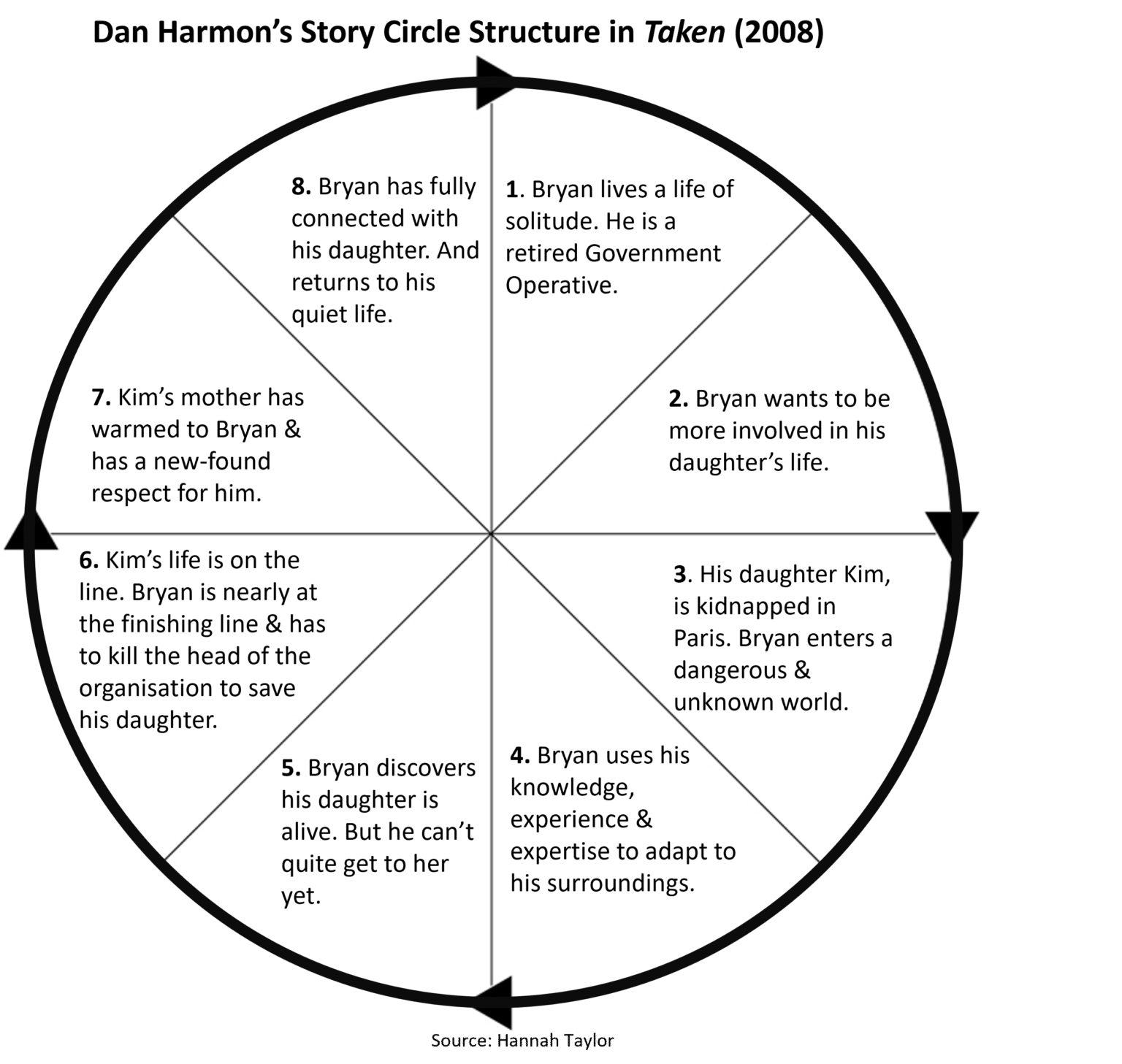
Character meets story arc - your character wants something, even if they are miserable and debilitated, they might want their misery to end, or people to empathize with them, or someone to feel their pain, etc. -- Story arc is how that character's wants/goals collide with the forces of the world, antagonist, opponents, sometimes it is a system film like Erin Brockovich, Spotlight, Dark Waters.
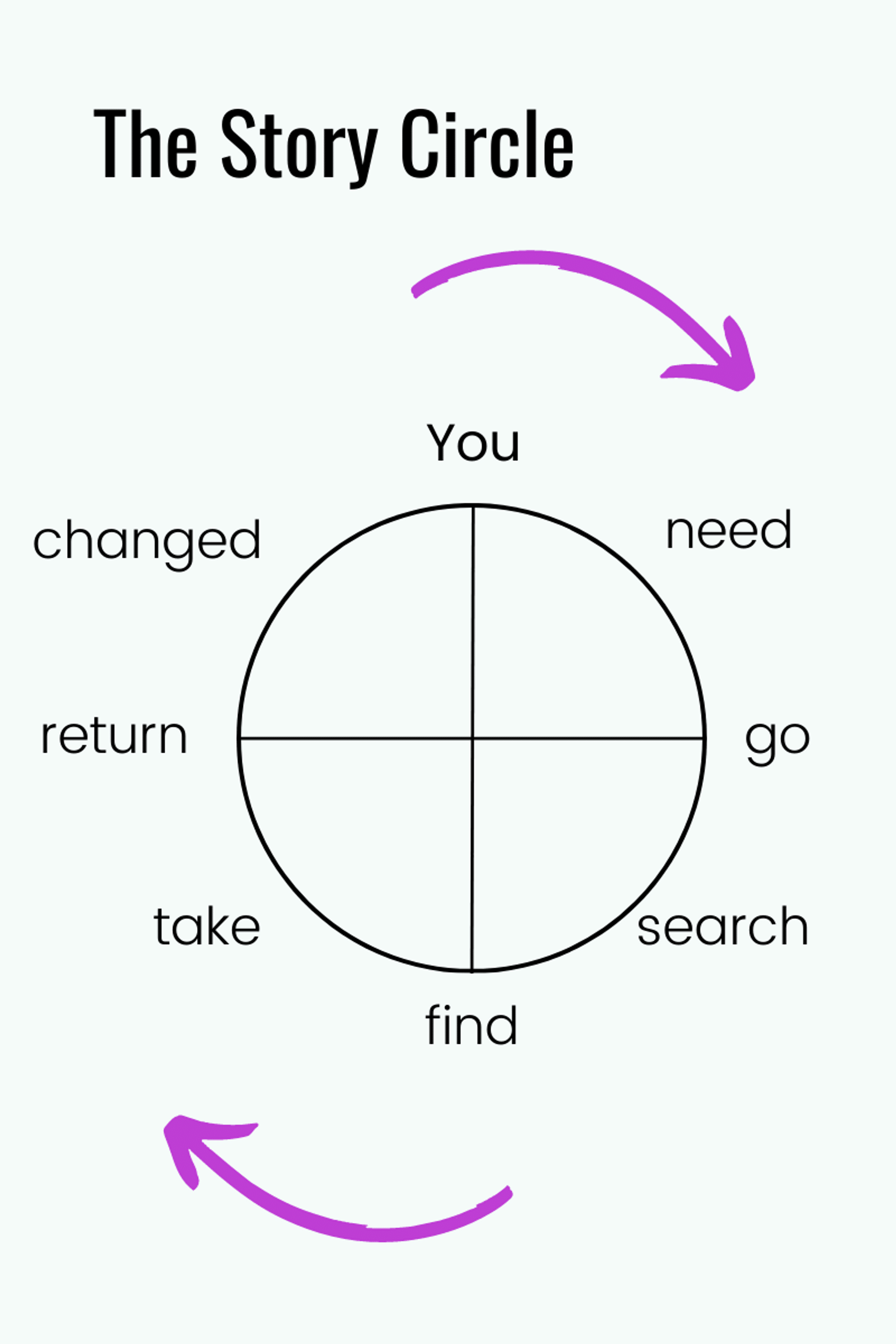
1 – You (in a zone of comfort)
2 - Need (desire something)
3 - Go (enter an unfamiliar situation)
4 - Search (adapt to the situation)
5 - Find (get what they desired)
6 - Take (pay a heavy price for winning)
7 - Return (to their familiar situation)
8 – Changed (they have overall changed)
Very few movies have a character that hasn’t changed by the end. Why? That would be boring. A journey typically requires change. Story, your movie, is a journey; the audience wants to take journey but they don’t want to feel like they are in anything less than expert hands.
Golden rule: EVERYTHING must pay off. Unless it is a macguffin (use sparingly).
BREAK
Exercise: write a story circle about your own life. (10-15 minutes)
What kind of movies are made? And how? (40 minutes)
Be inspired, inspiration is everywhere. A writer is the main force of ideation -- The writer is the most important person in film, they want you to think you are replaceable (and you are), but there is no chicken and egg argument, we know what comes first, it is competitive, so you MUST get your reps in. Writers write, if you write, no one can tell you you aren't a writer, and most importantly, the real writing is EDITING.
The story of HOW a movie gets made always starts in the same place. A writer writes…
So you must have a draft, a vomit draft even, to build off of, you do not build a house in one day, just as you are unlikely to write your script in a weekend no matter how much adderall or cocaine you do or coffee you drink. That is the main thing this class is meant to solve. The screenplay is a stretch across the spectrum between fiction (the artifice of filmmaking) and non-fiction (the audience's reaction to that artifice, whether that is immersion, the suspension of disbelief, or lack thereof, the lived experience of a movie theater, or a movie night at home with loved ones, a watch party with friends, etc)...
Movies are not made in a vacuum. They are NEVER made in a vacuum. It is true for writing too. Get yourself a writer’s group. Get a writing buddy. If you don’t have a writing friend, you can utilize a service like Screenplay Mechanic, a professional reader, or the Black List has evaluations that function similarly where you will get notes, but not as detailed. I also offering that service on occasion. There is no right amount of drafts you need before you have a “final draft” of your script, but there is a wrong amount, and that’s one.
When you start writing, you are so optimistic, I am going to write horror, I am going to write prestige drama, I am going to write arthouse quirky romances. The reality is, if you say, I am a writer in Hollywood, that doesn’t mean much. They need more specificity. You need a niche. So it’s not enough to say, “I am a writer,” you have to say “I am a (insert genre) writer).” So for example, a survey of the scripts I have in my backlog, I would say, “I write sociopolitical dark comedy,” or “I write gritty, inspirational sports films.”
So let’s look at the core of all movies: genre. If you want a movie to get made, lean into genre. Why? Genre is easy to understand. Back when we had video stores, it is how the aisles were labeled. It’s the category that tells the audience, this is what I am in the mood for, this is what I am interested in, this is the movie for me.
If you are the kind of genius writer that bends genre, excellent! But odds are, you are better suited started off with the basics. Look at Jordan Peele. Look at Ryan Coogler. Look at Issa Rae. They nailed genre and that has allowed them to take on more genre expansive, creative, boundary pushing, line blurring work. Everyone knows Quentin Tarantino for Pulp Fiction, but his first scripts, were pure genre, and his career has never veered from that despite his reputation. Same with Robert Rodriguez.
Blending genre is wonderful, and as time has gone on, it has become more prevalent — think of the word “Dramedy” dramatic comedy. So in no way am I discouraging you to do it; in fact, I do it myself since I love writing dramedy. Some genre blends are well known: rom-com, horror comedy, crime thriller, etc.
Importantly, the people who make movies — producers, production companies, studios — they are all looking for genre. If they have a big Oscar-bait picture, the odds are all their resources are tied into that, they aren’t willing to take on a second one that year and split their resources, or maybe they are, and are doubling down on their bet….If you make a movie of ANY genre, and set it around Christmas, boom! Your movie has a greater chance of getting made. Why? Christmas happens every year. So do the Oscars. So do the Golden Globes. So does Cannes. So does Sundance. There is always a demand for movies. So always be writing, always write your genre film, always write your genre-bending, genre-blending film.
So let’s look at genres…
- Genre films:
Dumb and Dumber
Halloween (Horror ROI; no stars)
Ex Machina
Moonlight
- Romance (universal language) - When Harry Met Sally, Titanic, Palm Springs, I Love You, Man, Begin Again, Thelma and Louise -- Every Movie is About Heartbreak, even if they win, you get to know the character so well that you as the audience know it would break their heart if they wouldn't get there, figuratively or literally, to be with that person, to be with their love…
MYTHBUSTER: Animation is not a genre; it is a medium.
Sources:
- True story - Green Rush, Casino, Dog Day Afternoon, Heat -- historical events, current events, historical fiction, true story doesn’t mean just one thing. So many movies push their artistic license so far, they are hardly true anymore.
- Judas and the Black Messiah, Gladiator, 1917, The Northman
- News article - All the President's Men, Almost Famous, Boogie Nights
- Sports - Macfarlane USA, Remember the Titans, Rocky, Above the Rim
- Biopic - Walk the Line, What's Love Got to Do With It, Blaze, La Bamba (also musicals), Goodfellas; authorized versus unathorized, often adaptations….
- Song - Love and Mercy, Straight Outta Compton, The Indian Runner
- Adaptation - Perks of Being a Wallflower, Black Panther, If Beale Street Could Talk
- Original - Boyz in the Hood, Sorry to Bother You, Blindspotting
- Social Media - Zola, Ingrid Goes West, Chef
- IP - Barbie, Lego, Uncharted
- Foreign - Departed - Infernal Affairs
- Subcultures - Spring Breakers, Kids, Green Room, Requiem for a Dream, Green Street Hooligans, Slacker, Hesher
The Importance of Scenes
Your movie is basically a collection of scenes. The purpose of a movie scene can be around character, around plot, around exposition, around conflict, around setting…but the main purpose of every scene is to move your story forward.
Exercise: Write your logline x2 (one original, one based off this magazine).
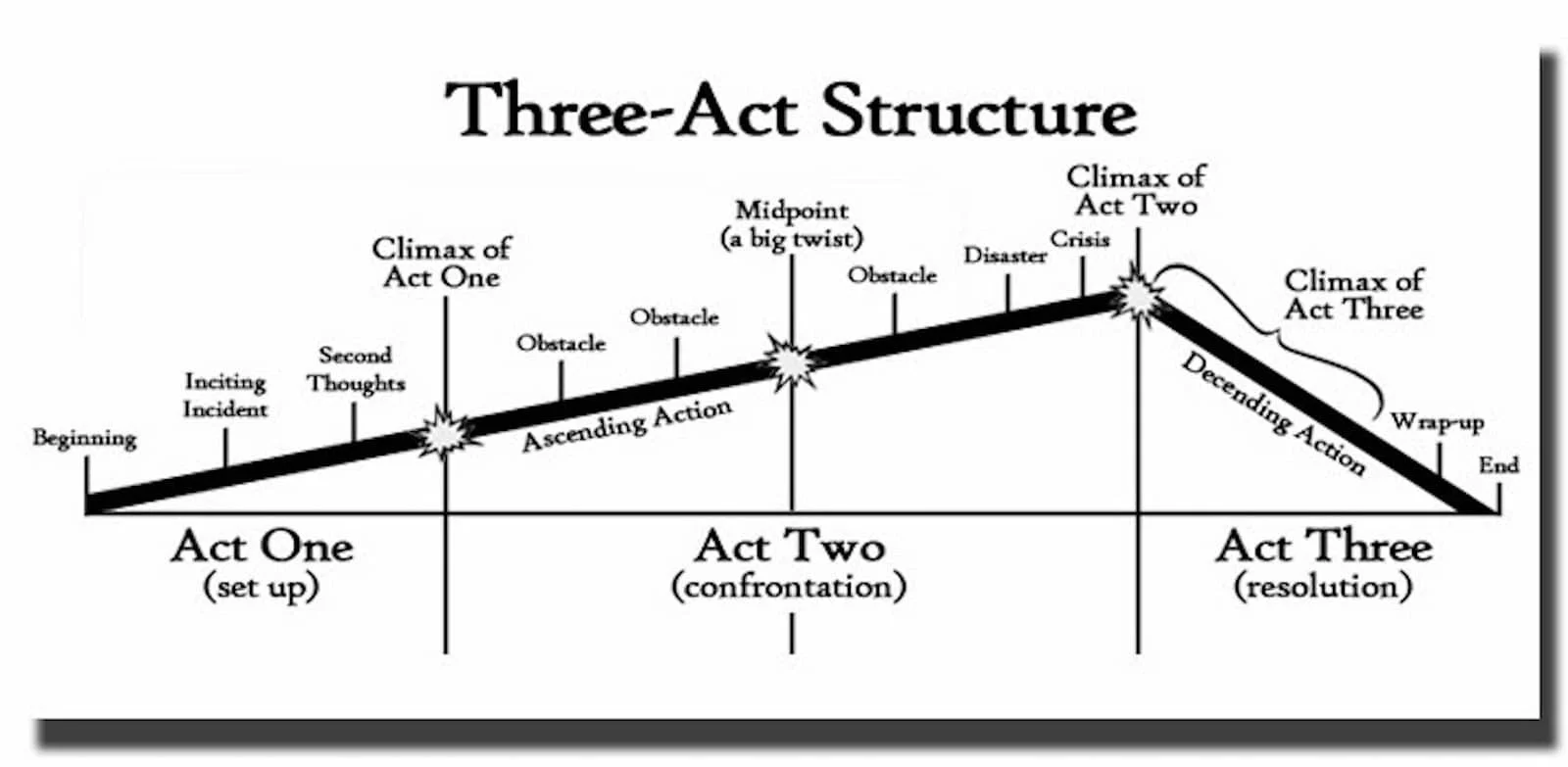
Inciting incident is everything. Perfect your first ten pages.
Use post-it notes or note cards to layout your three-act structure and the scenes that comprise them.
Contour outline service. Yes/no, yes/no, yes/no, etc.
B2B Method:
1 – Opening image: (1)
2 – Theme stated: (5)
3 – Set-up: (1-10)
4 – Catalyst: (12)
5 – Debate: (12-25)
6 – Break into Two: (25)
7 – B story: (30)
8 – Fun and games: (30-55)
9 – Midpoint: (55).
10 – Bad guys close in: (55-75)
11 – All is lost – (75)
12 – Dark Night of the Soul: (75-85)
13 – Break into Three: (85)
14 – Finale: (85-110)
15 -- Final image: (110)
HOW TO PITCH YOUR MOVIE:
The basic pitch you’ll always hear is, X meets Y. So The Joker is The King of Comedy meets Taxi Driver.
We are going to look closely at Oakland’s own Boots Riley, for the best pitch structure that exists, from this 2018 New York Times profile on his debut film, Sorry to Bother You.
“So he honed a spiel consisting of “various levels.” Level 1 was 23 words long, and on a recent afternoon, in a coffee shop in Riley’s hometown, Oakland, Calif., he recited it to me more or less exactly as he recited it over the years to potential actors, producers, investors and advice-givers:
“It’s an absurdist dark comedy with magical realism and science fiction, inspired by the world of telemarketing. It’s called ‘Sorry to Bother You.’ ”
Riley interrupted himself: “So it’s all those things, then — telemarketing. People usually laugh right there. ‘O.K., tell me more. ...’ ”
At which point he would take them to Level 2:
“Cassius Green is a black telemarketer with self-esteem issues and existential angst who discovers a magical way to make his voice sound like it’s overdubbed by a white actor.”
Riley let that premise sink in, then moved to Level 3:
“This catapults him up the ladder of telemarketing success, to the upper echelon of telemarketers, who sell weapons of mass destruction and slave labor via cold calling. In order to do this, he has to betray his friends who are organizing a telemarketers’ union.”
Resources (10 Minutes):
YouTube Study:
Books:
- Writing Movies for Fun and Profit
- Story
Podcasts:
- WTF
- Conan
Reality Checks (10 Minutes)/Final Thoughts:
- Short Film ---> Feature Pipeline
- Make What's Possible
Writing software: Highland 2 (free), Final Draft is the industry standard, $200. Adobe
Kurt Vonnegut's 8 rules for writing:
1. Use the time of a total stranger in such a way that he or she will not feel the time was wasted.
2. Give the reader at least one character he or she can root for.
3. Every character should want something, even if it is only a glass of water.
4. Every sentence must do one of two things—reveal character or advance the action.
5. Start as close to the end as possible.
6. Be a sadist. No matter how sweet and innocent your leading characters, make awful things happen to them-in order that the reader may see what they are made of.
7. Write to please just one person. If you open a window and make love to the world, so to speak, your story will get pneumonia.
8. Give your readers as much information as possible as soon as possible. To hell with suspense. Readers should have such complete understanding of what is going on, where and why, that they could finish the story themselves, should cockroaches eat the last few pages.